
Public Safety Answering Points (PSAPs) and emergency communications centers across North America are expected to answer true emergencies in seconds—yet a large share of incoming calls are routine, administrative, or better handled by another service. The result is predictable: longer queues, higher abandonment, more stress on call takers, and less capacity when a real crisis hits. An AI-based automated response solution can absorb much of this non-emergency volume while ensuring urgent calls still reach a human immediately.
This blog details key problems PSAPs face with non-emergency calls—and the practical ways an automated, AI-driven front end can help. Keep reading to learn more.
#1. High non-emergency call volume clogs emergency queues
What’s happening: In many centers, a majority of inbound contacts are non-emergency (information requests, administrative reports, service referrals). During storms, wildfires, or large public events, duplicate and “status check” calls can spike even higher, creating congestion exactly when 9-1-1 must stay clear.
Why it hurts PSAP operations: Routine calls compete with emergencies for the same call-takers and trunks. Even small delays can cascade into longer answer times, more transfers, and a higher risk that an urgent caller hangs up.
How an AI automated response solution helps: A virtual agent can answer the non-emergency number (and, where permitted, digital channels like web chat/SMS), identify intent (e.g., noise complaint, parking, bylaw, animal services), collect the minimum required details, and either resolve with guidance/self-service or route the call to the correct city/agency queue.
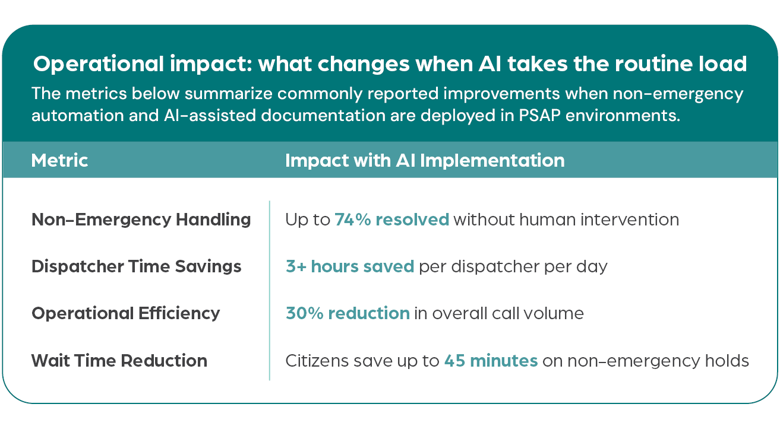
What improves: Non-urgent demand is removed from the emergency queue. Many agencies report that AI can resolve a large share of routine non-emergency contacts end-to-end (often cited at ~70%+ for the right call types), keeping call-takers available for life-safety events.
#2. Staffing shortages and burnout turn “busy” into “unsafe”
What’s happening: PSAPs across the U.S. and Canada continue to report persistent vacancies, forced overtime, and high attrition. When non-emergency contacts consume the same trained labor needed for emergencies, the center’s effective capacity shrinks.
How an AI automated response solution helps: AI can take the “first pass” on routine interactions—asking standardized questions, validating addresses/locations, and classifying incident types—then hand off a clean call summary when a human is needed. This reduces repetitive cognitive load and lets staff focus on complex, high-risk situations.
What improves: Call-takers spend less time on “information-only” calls and more time on true emergencies. In deployments focused on non-emergency automation and call summarization, centers often report hours of administrative time returned to each shift, supporting performance, morale, and retention.
#3. Long hold times create abandoned calls—and more repeat dialing
What’s happening: When non-emergency lines back up, callers can wait minutes (or longer) for routine issues. Many hang up and call back—sometimes repeatedly—which inflates inbound volume and makes queue metrics look even worse.
How an AI automated response solution helps: AI can answer many non-emergency calls concurrently, provide immediate acknowledgments, and offer structured self-service (or intelligent callbacks) instead of forcing callers to sit on hold.
What improves: Fewer abandoned calls, fewer redials, and faster completion of low-priority requests. Some agencies cite dramatic reductions in non-emergency hold time (including examples of tens of minutes saved), which directly reduces inbound “repeat” traffic.
#4. Language and accessibility gaps delay service for the people who need it most
What’s happening: Non-English callers may wait for an interpreter to join, and callers with speech/hearing disabilities may struggle to use voice-first processes. Even on non-emergency lines, these delays can escalate risk and erode trust.
How an AI automated response solution helps: AI can provide real-time multilingual conversation support (speech-to-text, translation, and text-to-speech) and offer text-based workflows (SMS/web) for callers who can’t—or prefer not to—communicate by voice.
What improves: Faster first contact, fewer transfers, and more equitable access to services—without tying up a call-taker while waiting for a third party to connect.
#5. Post-call paperwork and QA pull staff away from answering calls
What’s happening: Even when a call is “non-emergency,” it often requires documentation, tagging, and follow-up. Supervisors also need to review calls for QA, coaching, and incident reconstruction—work that can consume hours across a week.
How an AI automated response solution helps: Automated transcription, structured data capture, and instant call summaries reduce manual note-taking. Supervisors can search by keyword, topic, location, or time range instead of listening to long recordings.
What improves: Faster reporting, faster QA, and easier information retrieval (e.g., quickly finding when a license plate, address, or suspect description was mentioned)—which shortens investigation timelines and improves service quality.
Signs of a Well‑Designed AI Automated Response Solution
Not all AI solutions are created equal. When evaluating an AI-based automated response solution for non‑emergency calls, there are several core capabilities you should expect to see. The following characteristics define practical, PSAP‑ready AI—focused on protecting emergency access, supporting staff, and fitting into real-world operations.
-
Answer calls instantly, 24/7 to handle many non‑emergency interactions at once without placing callers on hold.
-
Identify caller intent and triage risk by detecting keywords or patterns that may indicate an emergency and immediately escalating to a live call‑taker or 911 with context.
-
Consistently collect structured information such as location, callback number, incident details, timing, and other jurisdiction‑specific data.
-
Resolve requests or route callers appropriately by providing guidance for common issues, creating service requests, or sending calls to the correct agency or queue.
-
Support multilingual and accessible communication across voice, SMS, and web channels, with real‑time translation and transcription as needed.
-
Automatically create a usable call record with transcripts, summaries, and key data fields to reduce manual documentation and after‑call work.
-
Keep humans firmly in control through clear escalation rules, audit logs, and supervisor oversight to review outcomes and adjust handling as needed.
What Changes When AI Takes the Routine Load
What This Means for PSAP Operations
Non-emergency calls aren’t “noise”—they’re legitimate community needs. But when they flow through the same front door as life-safety emergencies, they create queue congestion, burnout, and avoidable delays. AI-based automated response solutions give PSAPs a way to separate routine from urgent at the point of entry, document interactions automatically, and route callers to the right help faster.
If you’re evaluating automation, start by defining your top non-emergency call types, your escalation rules for anything that might be urgent, and the handoff points into your existing workflows. With the right guardrails, AI becomes a practical force multiplier—not a replacement—for trained emergency communications professionals.
Want to learn more about how AI can help manage non‑emergency call volume—without compromising emergency response? See our automated response solution firsthand at NENA 2026 and learn how it fits into existing PSAP workflows.
