
During an emergency, getting help to the right place and the right people inside your organization at the same time is most important. Many organizations already rely on Intrado Emergency Response Services (ERS) to ensure emergency calls are routed accurately and in compliance with Kari’s Law and RAY BAUM’s Act.
Now, with Intrado OneAlert™, that critical protection can extend far beyond the call itself — transforming 9‑1‑1 events into coordinated, real‑time action with notifications delivered to key stakeholders located across your entire campus.
Together, Intrado OneAlert and ERS is a true end‑to‑end safety ecosystem, unifying emergency calling, notifications, and response protocols without adding complexity or expensive hardware.
Why Emergency Call Compliance Isn’t Enough Anymore
Kari’s Law and RAY BAUM’s Act were designed to save lives by ensuring direct dialing of 9‑1‑1 and providing dispatchable location information to public safety answering points (PSAPs). Intrado ERS excels at exactly that — accurately routing emergency calls and location data to first responders. But today’s emergency landscape demands more.
With enforcement increasing, campuses expanding, hybrid work in play, and security threats becoming more common, organizations can no longer rely on emergency calls alone. A compliant call to 9‑1‑1 does not automatically notify security teams, trigger lockdown procedures, or alert people nearby. This is where OneAlert becomes the natural next step.
Turning a 9‑1‑1 Call into Immediate Awareness
The biggest advantage of integrating Intrado ERS with OneAlert is what happens the moment a 9‑1‑1 call is placed.
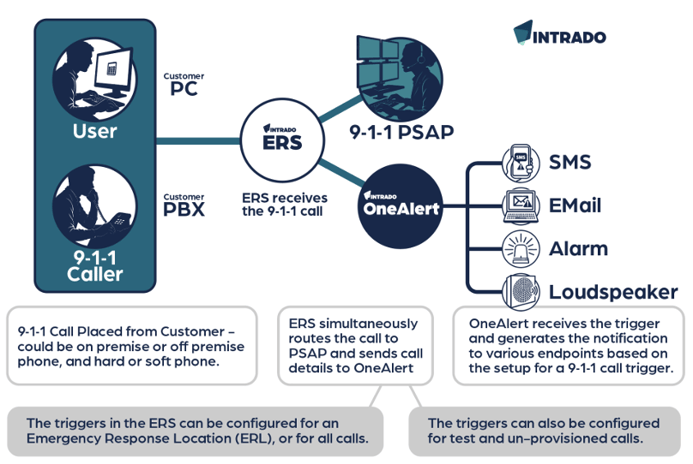
Step 1: An Emergency Call Is Placed — Anywhere, Any Device
As shown in the infographic, a 9‑1‑1 call can be initiated from:
-
An on‑premises desk phone
-
A softphone or mobile device
-
A hard or soft PBX endpoint
-
On‑site or off‑site locations
Intrado ERS receives the call and immediately determines the correct emergency response location.
Step 2: ERS Routes the Call and Sends the Details
ERS simultaneously:
-
Routes the emergency call to the appropriate 9‑1‑1 PSAP
-
Sends detailed call metadata including location information to OneAlert
This is a critical distinction: emergency services are contacted without delay, while internal teams are made aware in parallel.
Step 3: OneAlert Triggers Real‑Time Notifications
Based on how your organization configures its triggers, OneAlert can instantly generate alerts across multiple channels:
-
SMS and mobile alerts
-
Email notifications
-
Desktop pop‑ups
-
IP phone notifications
-
Public address and loudspeaker systems
-
Silent alarms
-
Lockdown initiations
-
And more
Instead of a single person knowing something is wrong, an entire response ecosystem activates at once.
Configurable Triggers for Real‑World Flexibility
Every organization handles emergencies differently and OneAlert was built with that reality in mind.
Triggers can be configured based on:
-
Specific Emergency Response Locations (ERLs)
-
All 9‑1‑1 calls, regardless of location
-
Test calls and un‑provisioned devices
-
Time of day or facility type
This flexibility ensures alerts are meaningful rather than overwhelming — directing action to the right people at the right time.
Unified Notifications Across the Entire Campus
OneAlert does more than just send messages — it unifies communication channels that often live in silos.
Security teams might receive silent alerts, facilities teams might see desktop notifications, and building occupants might hear clear instructions over IP phones or PA systems — all driven from the same trigger event.
The result:
-
Faster situation awareness
-
Reduced confusion and misinformation
-
Coordinated, confident responses
And because OneAlert integrates with most on‑premises systems already throughout your building, organizations can enhance emergency readiness without adding costly new hardware or layers of complexity.
Beyond Emergencies: Everyday Communication and Preparedness
While the ERS + OneAlert integration shines during critical events, OneAlert also supports non‑emergency notification needs, helping organizations stay prepared every day.
Use OneAlert for:
-
Routine emergency drills
-
Scheduled announcements
-
IP paging
-
Operational alerts
-
Campus‑wide messaging
This dual‑use approach ensures the system remains familiar, tested, and trusted so when a real emergency occurs, everyone knows what to expect.
A True End‑to‑End Safety Strategy
Intrado ERS ensures your organization meets compliance requirements and connects callers with first responders quickly and accurately. OneAlert builds on that foundation by making sure your internal teams are never in the dark.
Together, they deliver:
-
Compliance with Kari’s Law and RAY BAUM’s Act
-
Real‑time emergency awareness
-
Redundant, multi‑channel communication
-
Faster coordinated response
-
A scalable, future‑ready safety ecosystem
If your organization already trusts Intrado ERS, OneAlert is not an add‑on — it’s the logical next step in your duty of care plans to protect people, facilities, and operations.
Intrado – Always there in an emergency.
